Communists and Congress question RSS march permissions in Bengaluru, but what about the right to peaceful processions?


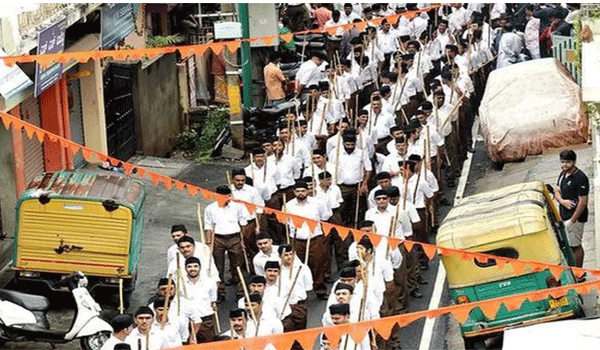
But a fundamental distinction needs to be made. An RSS route march is not a protest against the government or another organisation. It is a procession in which volunteers march together in uniform. Questioning the permissions granted for such an event is legitimate, but portraying the march itself as a problem simply because it is organised by the RSS raises questions about the motives behind the opposition.
A march is not a protestA protest is generally organised to express opposition to a policy, demand action or challenge a decision. A route march, by contrast, can be a public organisational activity without any demand being directed at the government. The RSS’s Vijayadashami marches are part of its annual activities, bringing swayamsevaks together in a public procession.
This distinction matters. If a procession has been organised in accordance with the law and the organisers comply with the conditions imposed by the authorities, disagreement with the organisation’s ideology should not, by itself, become a reason to oppose its right to march.
Communist leaders who raise questions about police permissions should also explain whether their objection concerns a specific violation of the rules or the RSS’s presence on the streets itself. If there is evidence that permission was not obtained or conditions were breached, it should be placed before the authorities. But a peaceful procession should not automatically be equated with a disruptive demonstration.
The question is simple: what exactly is the objection to a peaceful RSS route march, an identifiable violation of the law, or the fact that the RSS is conducting it?
The controversy has also brought Bengaluru’s 2021 order restricting protests and demonstrations to Freedom Park back into focus. Activists have argued that the restrictions make it difficult for citizens, students, workers and civil society groups to demonstrate near the offices or institutions connected to their grievances.
The Campaign for the Right to Protest has asked Chief Minister D K Shivakumar and Home Minister Priyank Kharge to reconsider the restrictions. Its members have cited examples of gatherings and demonstrations that faced restrictions, arguing that peaceful assembly should not be unnecessarily confined to one location.
However, the rules governing protests and those applicable to a particular route march must be examined on their own terms. A protest demanding government action is not automatically the same as an organisational procession. Whether a particular event requires permission, and what conditions apply, must be determined under the relevant rules and the facts of that event.
If Communist leaders believe the rules are unfair, they should make a consistent case for reform. They should also explain why the RSS’s peaceful procession should become a special point of contention when the question is how public spaces are regulated for different kinds of gatherings.
The question of permission for the RSS marches has become part of the political dispute. Congress leader and Karnataka Home Minister Priyank Kharge argued that informing the police or seeking cooperation was not necessarily the same as receiving formal permission. He also shared representations submitted by the RSS regarding planned marches in Bengaluru.
The police can settle the question by clarifying whether permission was granted, what conditions were imposed and how traffic and security arrangements were handled. If the organisers violated any condition, the authorities should take appropriate action. If the march was authorised and conducted peacefully, that should also be acknowledged.
The RSS’s record of route marches across Karnataka provides further context. The Bangalore Mirror report cited the organisation’s annual report for 2025-26, which recorded 562 route marches across the state involving 2,21,963 uniformed swayamsevaks. It also cited state government figures showing 518 RSS marches in Karnataka during 2025 without reported fighting, rioting or communal violence.
If so many marches have been carried out without any violence, then what is the issue?
Tamil Nadu’s RSS march dispute raises the same questionThe opposition to RSS route marches is not limited to Bengaluru. In Tamil Nadu, the organisation has repeatedly faced disputes over permission to conduct marches, leading to court proceedings.
In October 2026, the Madras High Court questioned why the RSS repeatedly had to approach the judiciary to hold its route marches. The court said the presence of mosques or churches along a proposed route could not, by itself, justify denying permission. The proceedings again brought the question of reasonable restrictions on peaceful processions into focus.
The issue is not whether everyone agrees with the RSS or its ideology. In a democracy, citizens and organisations will inevitably hold different political and ideological views. The question is whether those differences should determine who can exercise the right to assemble peacefully.
If there are genuine concerns about traffic, security or public order, the authorities can impose reasonable conditions, adjust routes or regulate timings. But opposition to an organisation’s ideology should not become a substitute for a lawful reason to restrict its activities.
That is why the distinction between a protest and a procession matters. The RSS’s Vijayadashami route march was an organisational event, not inherently a demonstration against the government or a rival group. If they believe the event violated a rule, they should identify the rule and provide evidence. If their objection is simply to the RSS marching in public, they should explain why a peaceful activity should be opposed on ideological grounds.
The Karnataka government and Bengaluru Police should make the permission process transparent and apply the rules consistently. But Communist leaders and others should also be clear about what they are opposing. A peaceful procession should be judged by its conduct and compliance with the law, not treated as a provocation merely because it is organised by the RSS.