Water must be seen not just as a resource, but as the foundation of life and culture: Sunil Ambekar


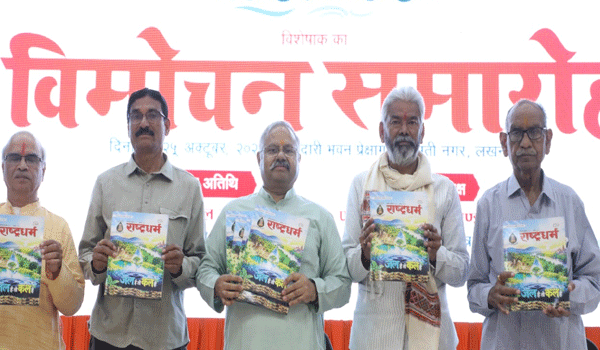
He emphasised that water must be viewed not merely as a resource but as the foundation of life and culture, requiring collective efforts for its conservation.
He said the water crisis was not merely about the shortage of water but was also linked to human behaviour towards nature and social responsibility. Human beings are not the masters of creation but an integral part of it. Therefore, development plans must consider the conservation of animals, birds, trees, plants, rivers and other natural resources alongside human needs.
Ambekar noted that Bharatiya culture regards rivers as mothers and water as the foundation of life. Putting this civilisational perspective into practice can help develop effective systems for water conservation.
He called upon young people to initiate similar efforts in their respective areas and help replicate successful models in other villages.
He emphasised that water is not the concern of any one state, social group or community, but an issue affecting the entire society and nation. The solution lies in collective responsibility rather than conflict.
Ambekar also stressed that urban planning must account for water availability, rainfall, population and the capacity of natural resources. Unplanned urbanisation and excessive exploitation of resources contribute to the worsening water crisis. He said economic progress must go hand in hand with environmental protection and safeguarding the interests of future generations.
Society must take an active role in water conservationPresiding over the programme, Padma Shri awardee Umashankar Pandey said that water conservation cannot be left to the government alone. Society must take the initiative and share collective responsibility.
He stressed the need to revive traditional water conservation systems and make literature on water conservation accessible to villages, gram panchayats and the general public.
Padma Shri Dr Popatrao Pawar cited the example of Hiware Bazar in Maharashtra and explained how water management, crop planning and community discipline can significantly reduce the impact of drought.
He highlighted the role played by collective measures such as regulating water-intensive cultivation, restrictions on grazing (charai bandi), restrictions on tree felling (kulhadi bandi) and prohibition of alcohol (nashabandi) in bringing positive changes to the village.
Pawar called for every gram panchayat to prepare a water conservation plan suited to local conditions and implement it with the active participation of the gram sabha.
Rashtradharma editor Ashok Vajpayee said environmental protection is an important component of the RSS initiative of Panch Parivartan, with water conservation forming an integral part of it.
He explained that the special issue, ‘Jal Hai Toh Kal Hai’, had been prepared with this objective. It covers religious and cultural perspectives on water, traditional conservation systems, present-day challenges and successful initiatives undertaken in different parts of the country.
The special issue aims to encourage a nationwide discussion on the water crisis and promote the wider adoption of traditional knowledge and successful conservation models.
The programme was conducted by Dr Anuj Mishra, a member of the editorial board, while Officer-in-Charge Director Sarveshchandra Dwivedi delivered the vote of thanks.
On the occasion, the seventh edition of Hamari Sanskritik Vichardhara Ke Mool Srot (The Fundamental Sources of Our Cultural Thought), authored by RSS Akhil Bharatiya Karyakarini member Suresh Soni, was also released.