RSS Akhil Bharatiya Karyakari Mandal Baithak | Bharat is moving forward on the path of progress: Sunil Ambeka


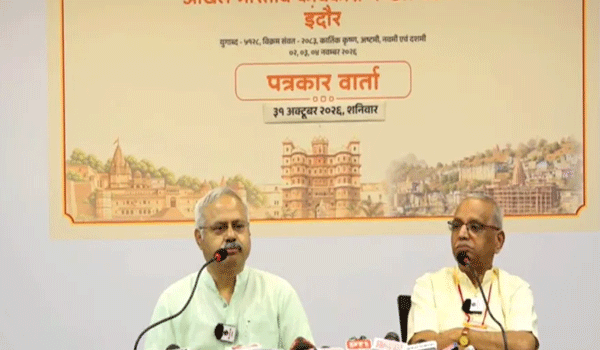
Addressing a press conference, Sunil Ambekar shared details of organisational expansion, centenary-year programmes, Hindu Sammelans, social initiatives, upcoming campaigns and discussions scheduled during the ongoing meeting. The number of daily shakhas across the country has reached 1,01,151, while the Sangh’s work has expanded to approximately 1,10,849 locations, including weekly and monthly milans, RSS Akhil Bharatiya Prachar Pramukh Sunil Ambekar said while addressing a press conference. He said that more than 13,000 new daily shakhas had been added in the past year compared to October last year.
He added that a three-year plan for organisational expansion had been prepared for the period preceding the centenary year, and special efforts had been undertaken towards this objective. The experiences gained and the figures recorded at the conclusion of the centenary year would be discussed and reviewed during the meeting, he said.
Sharing details of the centenary-year programmes, Sunil Ambekar said that 65,660 Hindu Sammelans had been organised across the country. Explaining the organisational arrangements, he said that Hindu Sammelans were organised at the basti level in cities, while in rural areas, a cluster of eight to ten villages constituted a mandal. In several places, two or three mandals also came together to organise these conferences.
Describing the response to these programmes as encouraging, Ambekar said that Swayamsevaks had shown great enthusiasm and society had extended widespread support. He said that during the Griha Sampark Abhiyan, Swayamsevaks reached households and received an enthusiastic response from society. People had also shown interest in associating with Sangh shakhas, its service activities and various organisations, as well as undertaking new programmes for the welfare of society, he said.
Ambekar said that the Sangh had adopted a policy under which its Swayamsevaks would extend cooperation, based on their experience, to institutions and organisations undertaking new initiatives and programmes for society. Together, efforts would be made to take forward activities aimed at the welfare of society, he said.
Highlighting women’s participation during the centenary year, Ambekar said that women had participated significantly in Griha Sampark and Hindu Sammelans. Keeping this participation in mind, discussions would also be held during the meeting on new programmes and initiatives for the coming period, he said.
Speaking about youth participation, Ambekar said that programmes and conferences had been organised in urban areas, rural areas and campuses. A large number of students and other young people had participated enthusiastically, while the participation of young women had also been encouraging, he said.
He said that discussions during these programmes covered various aspects of social life, including the aspirations of young people concerning themselves and the country. The discussions also focused on how these aspirations could be taken forward based on the Sangh’s positive approach, he said.
Ambekar said that the meeting would review these experiences and consider how the suggestions received and the people who came into contact with the Sangh through these programmes could be engaged further. A direction for future activities would also be formulated based on these discussions, he said.
On changes in the Sangh’s organisational structure, Ambekar said that discussions had taken place on the subject and a decision had been taken during the previous Pratinidhi Sabha. The organisational structure would be finalised following the ongoing meeting, and the complete structure would be put in place before the next Pratinidhi Sabha in March, he said.
Explaining the organisational election process, he said that it would begin at the Jila, Prant and Kshetra levels, followed by the election of the Akhil Bharatiya Sarkaryavah. The entire process would take place from the grassroots level upwards and would be completed by March during the Pratinidhi Sabha, which would be held in Nagpur this year, he said.
Ambekar said that public awareness on various issues would also be discussed during the meeting. He said that it was important for facts, along with the correct context and perspective on different subjects, to reach all sections of society so that people could understand these issues properly.
He said that the Sangh regularly undertook such activities through its Swayamsevaks and that certain campaigns would also be planned in the coming period. Information about these initiatives would be shared from time to time, he added.
Expressing concern over the increasing prevalence of drug abuse, particularly among the youth, Ambekar said that the issue had been a matter of concern during the last two-three Sangh meetings. He said that efforts at both the family and social levels are extremely necessary to address the growing impact of drug abuse.
He said that the Sangh had established contact and held discussions with several social and educational institutions on the issue. With everyone’s cooperation, more awareness initiatives and campaigns would be undertaken in the coming period, particularly to keep young people away from drug abuse, he said.
Referring to the previous coordination meeting of various organisations, Ambekar said that Sangh-inspired organisations had also shared information about campaigns already initiated in their respective fields to address the issue.
Ambekar said that the meeting would also review the Sarsanghchalak’s tours. Last year, his visits were primarily associated with the centenary celebrations, during which a large number of interaction programmes had been organised. Following the centenary year, a plan had been prepared for his tours during the current year, which would also be reviewed during the meeting, he said.
He said that during the foreign visits of Sarsanghchalak, Dr Bhagwat spoke about Bharat’s civilisational thought and its vision of how people across the world could live together in harmony and happiness. He explained that Bharat’s growing strength would be for the welfare of the entire world and discussed possible pathways towards achieving this objective, he said.
He said that Dr Bhagwat presented these views during interactions and conferences with prominent people from across the world throughout his visits, and the impact of these interactions was visible.
Ambekar said that the Sangh would take forward its initiative towards global outreach, international contact and dialogue. Engagement and dialogue would be expanded with several countries across the world, and the subject would also be discussed during the ongoing meeting, he said.
Ambekar said that this year marked the 650th birth anniversary year of the Sant Ravidas ji. The Sangh had issued a statement regarding this during its previous meeting, following which several programmes were being organised by workers across the country.
Referring to Panch Parivartan, Ambekar said that the Sangh had placed five subjects before society during the centenary year. He said that efforts had been made to take these initiatives to all sections of society through Griha Sampark, Hindu Sammelans and various other programmes during the centenary year.
Responding to a question on whether the Sangh would increase the number of its inspired organisations, Ambekar said that this is a continuous process. He explained that whenever new subjects and areas of work came to attention, initiatives are undertaken, and organisations could emerge over time to address those subjects. He said that there is a possibility of further expansion, but no immediate plan had been made in this regard.
On the role of new media and the content being circulated through various communication platforms, Ambekar said that the Sangh remained attentive to contemporary issues and regularly discussed and reviewed them. He said that during the centenary year, efforts had been made to communicate what the Sangh thinks, what Hindutva means, what Bharat represents, the direction in which the country should move, and the elements that create confusion and how society could overcome it.
He clarified that the Sangh did not oppose any medium or new technology. However, as human beings, people must certainly consider how such technology should be used. The Sangh would continue its efforts to create awareness in society on this subject, he said.
Reflecting on the discourse surrounding the Sangh, Ambekar said that discussions on the Sangh’s ideas, national thought and the concept of Hindutva had continued for the past 100 years. He said that the Sangh remained open to such discourse and that everyone, from the Sarsanghchalak onwards, is always ready for dialogue.
Referring to the issues raised by the Sarsanghchalak during his Vijayadashami address in Nagpur, Ambekar said that the meeting would also discuss how the issues highlighted in the address could be taken forward in society and what action programmes could be undertaken in this regard. Information about these discussions would be shared, he added.
Responding to a question on whether the Sangh needed a strategy to connect more young people with the organisation, Ambekar said that the Sangh did not require a separate strategy for this purpose, as its very structure is oriented towards reaching young people. He said that efforts to connect with youth are undertaken regularly and that young people continue to join the Sangh’s activities.
He said that thousands of people participated in the Sangh’s training programmes for those joining for the first time. Referring to the previous year’s figures, he said that approximately two lakh people had attended these programmes for training.
Ambekar added that special youth conferences had also been organised as part of the centenary-year programmes. He said that the Sangh continuously engaged with young people, addressed their questions and doubts, and presented its perspective. Such interactions also took place with the Sarsanghchalak at various places, he said.
Responding to a question on global instability, Bharat’s economic position and the role of the Sangh in strengthening the country, Ambekar said that despite instability across the world, Bharat has maintained stability and moving forward on the path of progress.
He said that the Sangh had always believed that the participation of society, particularly positive participation is essential for the progress of the country. Therefore, the Sangh continuously work towards increasing societal participation.
Ambekar said that various Sangh-inspired organisations also deliberated on such issues from time to time and presented their views before society and the Government through representations. He added that the Sangh is engaged in all necessary efforts to ensure that Bharat progressed in every field and became stronger.
Responding to a question about the Sangh’s response to public movements and protests, Ambekar asked why the Sangh should be considered either in favour of or against every issue raised in the country. He said that people had the right to raise questions on issues concerning the nation.
However, he said that everyone must remain vigilant to ensure that movements in the country are in the national interest and aimed at taking the country forward. It is important to ensure that no forces misused such movements or that elements working against the country’s interests did not enter them. The Sangh remained attentive to this aspect and would continue to do so, he said.
Explaining the concept of Param Vaibhav, Ambekar said that it meant making Bharat so prosperous that no one in the country faced deprivation. He said that the country should become prosperous, secure and free from social evils, while developing a sense of affection and love among people for one another.
He said that when Bharat reached this level in every respect, it would be capable of contributing to its own welfare as well as the welfare of the world. It would also have the strength to support good forces and prevent destructive and terrorist forces from harming the world. Developing and sustaining such national capacity is the objective of Param Vaibhav, he said.
Responding to a question concerning the UGC circular and concerns raised by sections of society, Ambekar said that the Sangh had already clarified its position on the circular and described it as unbalanced.
He said that the issue had been brought to the attention of the concerned authorities, and both the Government and the UGC had taken note of it. The matter had also been stayed by the court and was currently under consideration.
When asked whether the Sangh is considering registration as an organisation, Ambekar said that there is no such thing under consideration.