Seshadri ji gave 1000s of Swayamsevaks endless inspiration to work for nation: RSS Sarkaryavah Dattatreya ji at S-VYASA


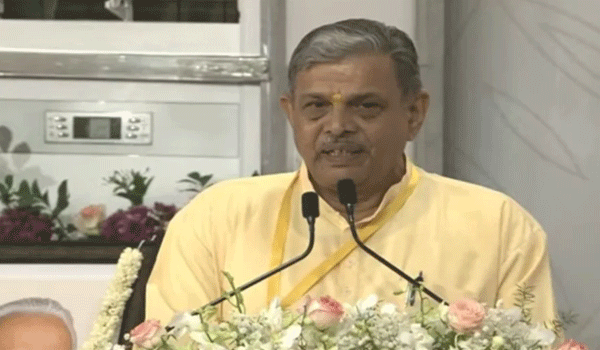
On Friday, at the inauguration of the golden jubilee celebrations of the Swami Vivekananda Yoga Anusandhana Samsthana (S-VYASA) University and the commemoration of Seshadri’s birth centenary, held at Prashanti Kutiram in Jigani, Bengaluru, in the presence of Prime Minister Narendra Modi, Hosabale ji shared many episodes from his life. They show how one person’s austerity, sacrifice, simplicity and dedication to the organisation can change the direction of thousands of lives. Citing Seshadri’s 32 books, more than 10,000 letters and his travels across the country, he described his ideas as lasting guidance for the nation and society. At the same event, an initiative was also announced to set up a state-of-the-art “Ritambhara” laboratory to take scientific research on yoga to new heights.
A broad body of thought on Indian culture and society, gathered in 32 booksHosabale ji said that, through his writing, H.V. Seshadri placed before Indian culture, society, history and young people a wide world of ideas. His 32 books are the result of his study, experience, observation and reflection. His writings and books, in Kannada as well as English and Hindi, have given direction to people working in national life. His literature is an important legacy of the Indian knowledge tradition for future generations.
Hosabale ji said that, besides strengthening the Sangh’s work in Karnataka, Seshadri ji played an important role in advancing the organisation’s service activities at the national level. Seshadri ji’s contribution was notable in carrying forward the initiative taken, under the guidance of Yadavrao Joshi ji, to give Karnataka’s service work an organised form. Gradually, these same service activities grew into a nationwide movement.
Seshadri ji travelled throughout the year, reaching even small villages across the country to speak with swayamsevaks. He was personally acquainted with thousands, even lakhs, of workers. He wrote more than 10,000 letters to guide them. These letters showed his warm support not only in matters of organisational work but also in workers’ personal problems, difficulties and circumstances.
His extraordinary simplicity shone even through a broken mirrorCiting Seshadri ji’s simplicity, Hosabale recounted an interesting episode. He said he once saw Seshadri ji using a broken mirror while shaving. He told him the mirror was broken and should be replaced. Seshadri ji replied easily that he could see as much as he needed to see, and there was no need to see more.
When it was pointed out to him that, in our tradition, looking into a broken mirror is considered inauspicious, he answered with a smile: what more is there to be auspicious in this life? Everything that was to happen has already happened.
Hosabale ji said Seshadri ji’s personality was so simple that, from his dress and way of life, it was hard to guess that he was an MSc gold medallist and had been Sarkaryavah of a large organisation like the RSS. Alongside his scholarship and organisational ability, he had remarkable humility.
Tying a worker’s shoelaces, he bound him to national work for lifeRecounting an episode about one swayamsevak, Hosabale said that Seshadri ji once personally tied properly the shoelaces of that swayamsevak’s uniform shoes. This small gesture left such a deep impression on the swayamsevak’s mind that he developed a lifelong commitment to national work. That worker would later say that Seshadri ji had not merely tied his shoelaces; he had bound him to the organisation and the nation for life.
Through this episode, Hosabale ji showed that Seshadri ji’s organisational skill was not limited to big speeches and instructions. His conduct, warmth and sensitivity towards workers were his greatest strength.
Seshadri ji saw yoga as a means of transforming life and societyReferring to Seshadri ji’s ideas on yoga, Hosabale said that for him yoga was not limited to physical and mental health. He regarded it as the basis for making the whole of life better and for transforming society. Putting the message of the Gita into practice, he inspired swayamsevaks and their families towards yoga, Indian culture and study.
He cited the Gita verse which describes as a sattvik doer the person who is free from attachment and ego, acts with steadfastness and enthusiasm, and remains even-minded in success and failure: Muktasango’nahamvadi dhrityutsahasamanvitah; siddhyasiddhyor nirvikarah karta sattvik ucyate. According to Hosabale, Seshadri ji’s life exemplified this spirit. He had love and compassion for all, and remained constantly engaged in his duty, unaffected by the success or failure of the work.
Hosabale ji said that Seshadri ji also guided S-VYASA and the yoga movement. Today the institution is working to establish, on a scientific basis, the role of pranayama in yoga, medicine, health research and the development of the human body and mind. It is gratifying to see the institution playing an important role in advancing yoga at the international academic and scientific level.
Scientific research on the state of samadhi tooA special attraction of the S-VYASA golden jubilee celebrations was the initiative to set up a state-of-the-art laboratory named “Ritambhara”, intended to give yoga research a new direction. Through it, there are plans to advance scientific study and research on the subtle and higher dimensions of yoga, especially the state of samadhi. Its aim is to understand, through modern research methods, the profound meditative experiences described in the Indian yoga tradition.
Prime Minister Narendra Modi laid the foundation stone of the institution’s new Golden Jubilee Administrative Block. He also inaugurated S-VYASA’s off-campus centre in Thiruvananthapuram, Kerala.
Five decades of a journey, and a resolve for Viksit Bharat 2047Established in 1975, S-VYASA has in five decades done notable work in linking Indian yoga science with modern science and medical research. Prashanti Kutiram in Bengaluru is its main centre, where study and research are carried out on subjects related to yoga, health, mental balance and spiritual consciousness.
The theme of the ten-day golden jubilee festival, held from 13 to 23 November, is “Towards Viksit Bharat 2047”. The event is also significant in the context of the Sangh’s centenary year. Its ideological backdrop shows a harmony between the Panch Parivartan resolve (concerning social harmony, kutumb prabodhan or family awakening, environmental protection, swadeshi conduct and civic duty) and a yoga-based healthy lifestyle.
Among the many dignitaries present at the ceremony were Padma Dr H.R. Nagendra, President of the VYASA Society; Prem Bhandari, Chief Adviser for International Affairs; Swatantra Dev Singh, Uttar Pradesh’s Minister for Jal Shakti; Satish Gupta and Rakesh Kumar Tiwari, Vice-Presidents of the Society; and Ahn Byung-gu, a representative from South Korea.