Youth of Bharat have no hesitation in chanting ‘Jai Shri Ram’ & ‘Bharat Mata Ki Jai’: Sunil Ambekar


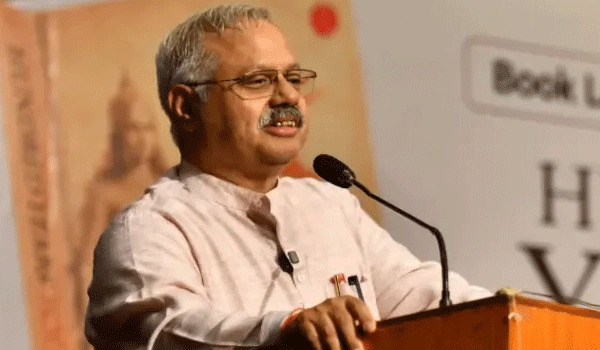
He said that attempts are being made from several parts of the world to mislead the youth of Bharat. Such efforts have succeeded in several countries, destabilising their systems. However, these conspiracies are not succeeding in Bharat because young people have faith in the country’s institutions and system. They are committed to the Constitution and will never allow the nation to be defeated. Instead of distrusting young people, society should repose faith in them.
He observed that the Sangh and its thought have always remained young. This is why the organisation continues to work as the voice of the youth of every generation. Despite being an old organisation, its relevance has remained intact.
Responding to questions about repeated allegations against the Sangh, Ambekar said that such discussions keep the organisation in public discourse and help people gain greater clarity about it. Since the Sangh is an organisation of society, questions about it, new discussions and the emergence of new ideas are natural.
He said that whenever shortcomings are noticed in Hindu society, questions are raised about the Sangh. This is because the organisation has always considered the nation and society its own and has worked with a sense of responsibility towards them. Only when people consider the nation and society their own will they take responsibility for resolving their problems.
He added that today’s young generation has faith in the nation and Bharatiya youth will not compromise on their culture.
Recalling the vision behind the establishment of the RSS, Ambekar said that Dr Keshav Baliram Hedgewar founded the organisation with the objective of strengthening cultural confidence. Today, lakhs of people are actively working in society with this cultural confidence, and young people feel increasingly confident about their Bharatiya identity.
Ambekar said that the future of Bharat is bright. Although challenges will continue to emerge, today’s youth are capable of facing them. He said that the thoughts expressed in ‘Hundred Years Young’ are not limited to the 20 contributors but represent the feelings and aspirations of millions of young people. He added that the title of the book appropriately reflects its contents.
He said that even in the most difficult circumstances, the Sangh has consistently attempted to foster a spirit of dialogue in society. Its initiatives to establish communication with young people in regions such as Manipur are an example of this effort.
He further observed that history offers several examples demonstrating that when young people understand Bharat, they stand firmly to protect the nation.
Speaking on the occasion, book editor Rashmi Samant said that editing the book was one of the most honourable moments of her life. She explained that the objective was not merely to present the hundred-year journey of the Rashtriya Swayamsevak Sangh as the history of an organisation, but to document it through the lived experiences of people associated with it.
She said that since the establishment of the Sangh in 1925, young people have played an important role in its growth. At various turning points in history, youth have played a decisive role in shaping the direction of the nation. The book was conceptualised around this very thought.
Twenty individuals from Bharat and abroad have documented their association with the Sangh through personal experiences. Some have shared the inspiration they received from their fathers, grandfathers and senior family members, while others have recorded their own experiences and interactions with the organisation.
Samant said that even in the age of artificial intelligence and technologies such as Google, the relevance of books would not diminish. Technology can provide information, but books uniquely preserve the life experiences, memories and emotions of individuals.
Discussing the working style of the Sangh, she highlighted one of its core values, ‘Prasiddhi Paranmukhta’, which means working continuously for the welfare of society without seeking personal publicity, recognition or honour.
She said that the achievements of the Sangh visible in the public domain represent only a small part of its overall work. Thousands of service activities take place behind the scenes, which generally remain unknown to society.
She said that during difficult circumstances, including natural disasters, wars, famines and the COVID pandemic, Sangh volunteers have undertaken service activities. Thousands of such workers continue their efforts without seeking personal recognition. Their dedication forms the foundation of the Sangh’s hundred-year journey.
Samant also referred to a historical event following the 1962 Bharat-China war. According to her, then Prime Minister Jawaharlal Nehru invited approximately 3,500 RSS volunteers to participate in the Republic Day parade in 1963. A photograph of this historic occasion has been featured on the cover of the book.
She revealed that she had also documented her own experiences in the book as the daughter of a Swayamsevak. Most of the contributors are not professional writers but individuals who have shared what they witnessed, experienced and understood in their lives. Therefore, the book is not merely a literary work but an effort to bring the personal experiences of different individuals before readers.
Samant also referred to RSS Sarsanghchalak Dr Mohan Bhagwat’s observation that the Sangh is an organisation that continuously evolves and keeps developing. She said that the hundred-year journey of the Sangh is not a final destination but an ongoing journey of service to society.
She reiterated that ‘Hundred Years Young: Rashtriya Swayamsevak Sangh’ presents the organisation’s history not merely through events and achievements but through the life experiences of 20 individuals associated with it.
Contributors from diverse fields share their experiencesThe book features personal accounts from individuals associated with law, cinema, sports, journalism, industry, public life and education.
Aditya Srinivasan, a Supreme Court advocate and Harvard graduate, has shared the life lessons he learnt through his association with the Sangh. Filmmaker Vijay Subramaniam has written about the Sangh’s role in keeping Bharat’s cultural soul alive.
A legislator from Germany’s state of Hesse has shared his experience of understanding Bharatiya identity through the Sangh despite his left-wing background, as well as his role in starting a shakha in Frankfurt.
Actor Vikrant Massey has documented his experiences of witnessing free education and service activities conducted by the Sangh in remote areas during film shoots.
Journalist Rubika Liyaquat has shared her experiences of growing up in a Muslim family in Jaipur and her visit to Reshimbagh. Ankit Gupta has written about the assistance provided by the Sangh to weaker sections during the COVID pandemic.
Arjuna Award-winning basketball player Vishesh Raghuvanshi has described how his experiences at a shakha inspired him to take up a non-traditional sport. Mumbai-based entrepreneur Brinda Ghotak has shared her observations on the Sangh’s management methods and organisational structure.
Swami Saraswati Sagar has discussed the values he imbibed through the Sangh and its service activities associated with scholarships.
Actress Bhasha Sumbli has recalled her childhood memories of camps organised by the Sangh for displaced Kashmiri Pandits.
Nikhil Chhabra, a third-generation member of a family displaced during Partition, has expressed his association with the Sangh and the sense of belonging he experienced. Rishabh Shah, who leads a youth-driven Model United Nations initiative, has written about the discipline and organisational arrangements he witnessed in Nagpur.
Olympic medallist badminton player Saina Nehwal has shared her experiences in the concluding article of the book. Additionally, a British scholar has analysed the Sangh’s hundred-year journey from a European liberal perspective.
RSS Dakshin Madhya Kshetra Karyavah Na. Tippeswamy, Karnataka Dakshin Prant Karyavah Dr M. Jayaprakash, educationist and thinker Dr P.V. Krishnabhatt, Karnataka and Uttar Prant Prachar Pramukh Arun Kumar, and Karnataka Dakshin Prant Prachar Pramukh Rajesh Padmar were present at the programme.
Thinkers, social workers, authors and young writers also participated in the event.