RSS ABKM 2026 | Creating unrest, deepening divisions to achieve something is not in interest of society: Dattatreya ji


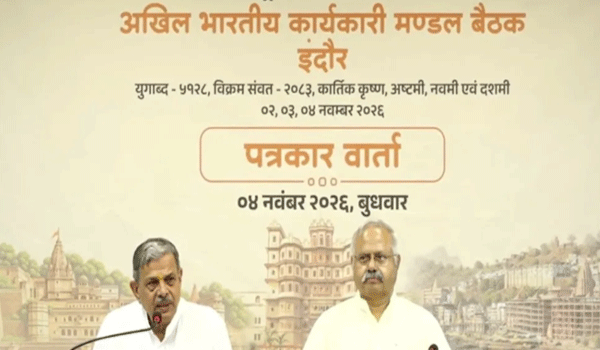
RSS Sarkaryavah Dattatreya Hosabale informed that 407 members were expected to attend the meeting. However, six Karyakartas could not attend due to health-related reasons or other family engagements.
While reflecting on the completion of the RSS centenary year, Hosabale said that the centenary year, which began with the completion of 100 years of the Sangh and continued into its 101st year, concluded with this year’s Vijayadashami. He said that during the centenary year, programmes were organised across the country and at various locations around the world. Society extended extensive cooperation during these programmes, while Swayamsevaks reached out to different sections of society through various activities.
He further said that efforts were made to establish contact with the Sajjan Shakti of society, introduce them to the Sangh and express gratitude for the cooperation extended by them.
While highlighting the relief and rehabilitation work undertaken by RSS Swayamsevaks during recent natural disasters, Hosabale said that heavy rainfall and floods had caused considerable damage in different parts of the country.
He said that Swayamsevaks made significant efforts to undertake relief operations in several affected areas. They also worked in cooperation with society, various social organisations and religious institutions.
He said that floods are generally not experienced in Upper Assam, and people in districts such as Sivasagar and Jorhat did not have much experience of such flooding. Unlike other parts of Assam, where floods are a recurring phenomenon, the region bordering Nagaland’s hilly areas witnessed an unexpected crisis due to extremely heavy rainfall.
Hosabale said that 67,700 families across 805 villages were affected by the floods, while more than 1,500 houses were completely destroyed. He further said that more than 1,600 Swayamsevaks reached out to 42,200 families and provided immediate assistance in the form of food, water, medicines and other essential supplies.
He said that while the administration undertook its responsibilities, Swayamsevaks also fulfilled their social responsibility by extending assistance to the affected people.
He further said that arrangements had been made to provide construction materials for rebuilding the houses of approximately 150 affected families. Rehabilitation work would continue in the coming days.
Hosabale said that more than Rs 5 crore was collected through the cooperation of society, and Swayamsevaks made efforts to provide food, water, medicines and other essential assistance to the affected people.
While speaking about the damage caused by the cyclone in Odisha and Andhra Pradesh, Hosabale said that several coastal districts, including Kandhamal and Ganjam in Odisha and Srikakulam and Vijayawada in Andhra Pradesh, suffered damage to houses and agricultural crops.
He said that a large number of livestock perished, while thousands of coconut trees were destroyed. Electricity supply remained disrupted in several areas for five to six days after electric poles were uprooted. He said that Swayamsevaks reached these areas and helped restore electricity by erecting electric poles. They also made arrangements for lighting in areas without electricity and provided food and water to affected people.
He further highlighted the difficulties faced by children and fishing communities, stating that arrangements were also made for small boats and fishing nets required by local fishermen. He said swayamsevaks, with the cooperation of society, undertook various Seva activities to address these challenges.
While highlighting the Seva Karya in Uttar Pradesh, Hosabale said that heavy rainfall had caused flooding in Lucknow and Chitrakoot. He said that more than 40,000 families were affected in Lucknow, while approximately 25,000 families had to move to safer locations. Working alongside the administration, more than 300 Swayamsevaks continuously undertook relief activities for four to five days to assist the residents of Lucknow.
He further said that Chitrakoot also witnessed considerable damage, with more than 2,000 families affected across 28 villages due to the overflowing Mandakini River. Approximately 350 Swayamsevaks worked round the clock in the affected areas.
Hosabale said that Swayamsevaks continued providing food and water to more than 6,000 people for eight to ten days. They also made efforts to provide medical assistance to approximately 5,600 people suffering from different ailments.
While speaking about the expansion of Sangh Karya during the year, Hosabale said that the RSS undertook efforts to expand its organisational activities in two different ways. He said that one aspect involved the regular annual expansion of Sangh Karya. He further explained that another initiative involved organising shakhas at new locations for periods ranging from one week to ten days.
Hosabale said that more than 1 lakh new shakhas established during the period. He said that Swayamsevaks had planned and organised these shakhas in new villages and residential localities to familiarise people with the Sangh’s activities.
While presenting the organisational expansion figures of the Sangh, RSS Sarkaryavah Dattatreya Hosabale said that, RSS shakhas are currently functioning at 63,208 locations across the country. He said that this represents an increase of 8,156 locations compared to the figures presented at the ABKM meeting in October last year.
He further said that a total of 99,433 daily shakhas are currently operational across these locations, registering an increase of 12,025 shakhas since October last year.
Hosabale further said that apart from daily shakhas, the Sangh also organises weekly gatherings, (Saptahik Milan), for those who are unable to attend a daily shakha. He said that there are currently 34,982 such weekly gatherings across the country, registering an increase of more than 2,600 compared to the previous year.
He further explained that in remote areas, Janjati regions and hilly locations, monthly gatherings (Masik Mandali) are organised to maintain regular contact and engagement with society. Hosabale said that there are currently 14,096 such monthly gatherings, an increase of 463 compared to the previous year.
He said that during the year, the RSS increased its presence by 10,231 locations. At present, Sangh activities are being conducted at a total of 1,03,397 locations across the country.
Hindu SammelansWhile reflecting on the programmes organised during the RSS centenary year, Hosabale said that extensive efforts were made to organise Hindu Sammelans, also referred to as Dharma Sammelans, bringing together people from different sections of Hindu society.
He said that a total of 65,664 Hindu Sammelans were organised across the country, covering 3,08,429 villages. These programmes were organised with the objective of bringing society together and promoting the principles of Panch Parivartan. He explained that the discussions focused on encouraging people to stay away from social evils and addictions, strengthening unity within villages, promoting mutual cooperation and adopting a positive way of life.
Hosabale said that even where differences exist among people in villages due to various reasons, efforts must be made to work together for the collective welfare of society. The message conveyed through Hindu Sammelans and Dharma Sammelans was to rise above these differences and work together for the welfare of their villages and residential localities.
Explaining the scale of these programmes, he said that in urban areas, a residential locality with a population of approximately 10,000 is generally considered a Basti for organisational purposes. A total of 28,514 Basti Sammelans were organised in urban areas, while 37,080 Sammelans were held in rural areas. Together, these accounted for 65,664 Hindu Sammelans across the country.
He further said that approximately 4,93,76,000 people participated in these programmes, bringing the total participation close to five crore.
Highlighting the outreach in different geographical regions, Hosabale said that 28 Hindu Sammelans and Dharma Sammelans were organised in Arunachal Pradesh, while programmes were also conducted in Ladakh. In the Andaman and Nicobar Islands, a programme was organised in Port Blair, which witnessed the participation of more than 5,000 people.
While highlighting the nationwide Griha Sampark Abhiyan undertaken during the centenary year, Hosabale said that a three-week house-to-house contact campaign was organised in every prant to provide information about the Sangh and introduce people to its activities and objectives.
He said that during this campaign, Swayamsevaks reached out to 4,63,340 villages and 41,825 Bastis in urban areas. In total, the campaign covered 10,22,05,665 households across the country.
Explaining the nature of the campaign, Hosabale said that Swayamsevaks generally spent between 5 and 25 minutes at each household, interacting with families, sharing information about the Sangh and explaining its activities and the vision of Panch Parivartan.
He said that approximately 95 to 99 per cent of the people welcomed the Swayamsevaks during the campaign. Hosabale further said that there are 59,008 Mandals across the country, of which Swayamsevaks were able to establish contact with 54,937 Mandals during the Griha Sampark Abhiyan.
Youth outreach programmesWhile speaking about the initiatives undertaken to connect with young people during the centenary year, Hosabale said that special programmes were organised for individuals below 35 years of age, including college students and young professionals.
He said that programmes and interactive sessions for college students were organised at 21,237 locations, while initiatives for young professionals were conducted at 14,285 locations. Together, a total of 57,243 programmes were organised to facilitate dialogue and interaction with the youth.
Hosabale said that these programmes witnessed the participation of 31,26,404 college students and 6,90,800 young professionals. The initiatives were aimed at engaging young people, introducing them to the Sangh’s activities and encouraging their participation in discussions on various social issues.
Prabudh Jan GosthiWhile highlighting the outreach among Prabudh Jan Gosthi, (intellectuals and distinguished members of society), Hosabale said that intellectual gatherings were organised at district headquarters across the country.
He said that a total of 3,207 such gatherings were organised, witnessing the participation of approximately 4,29,000 people. These programmes were conducted in one or two sessions, providing an opportunity for interaction and discussion with members of the intellectual community.
Social Harmony meetingsHosabale highlighted the Social Harmony Meetings organised during the centenary year. He said that a total of 1,346 meetings were organised in cities and 5,028 meetings in blocks, witnessing the participation of 3,79,581 representatives and social leaders.
Explaining the nature of these gatherings, Hosabale said that representatives of various social organisations and institutions belonging to different traditions and communities were invited. These included representatives of Jain, Sikh and Buddhist communities, along with leaders of different social and community organisations.
He said that the objective behind bringing these representatives together was to convey the message of social harmony and unity that was shared during the Hindu Sammelans.
While outlining the future course of action discussed during the Akhil Bharatiya Karyakari Mandal meeting, Hosabale said that the Sangh would continue engaging with the Sajjan Shakti of society to ensure that the message and initiatives of Panch Parivartan are taken forward at different levels.
He said that the objective is to maintain continuous contact with socially conscious individuals and encourage them to work towards the implementation of Panch Parivartan in their respective areas and capacities. He emphasised that the initiatives undertaken during the centenary year should be carried forward through sustained engagement and collective social efforts.
While highlighting another important issue discussed during the meeting, Hosabale said that concerns had emerged at several places regarding the growing habit of drug consumption and addiction among young people. He said that this had been a challenge facing the country for several years and it is encouraging that the Government is also giving attention to the issue.
He said that, Sangh would work towards bringing together various organisations, institutions and NGOs engaged in addressing drug addiction and preventing young people from falling prey to drugs and narcotics.
Hosabale highlighted that drug trafficking is linked to extensive international trade and large networks operating across borders. He said that controlling and eliminating these networks is primarily the responsibility of the administration. He also referred to important steps taken by the Union Government and the Union Home Minister in this direction.
He further said that attention must also be given to those who had already fallen prey to addiction. Their rehabilitation, mental counselling and family-related concerns needed to be addressed. He emphasised that several social organisations should be brought together to work on these aspects.
RSS New organisational structureWhile explaining the proposed organisational changes in the Sangh, Hosabale said that the RSS had so far been functioning through 46 Prants (provinces). Following the upcoming organisational process in November and December, the structure would be reorganised into 88 Sambhags (divisions).
He said that the election of Prant Sanghchalaks and the formation of new executive committees within the Prant would take place during this period.
Hosabale said that the meeting also discussed the organisational planning and distribution of responsibilities across these 88 Sambhags to ensure the effective expansion and coordination of Sangh Karya throughout the country.
While speaking about the three statements issued during the meeting, Hosabale highlighted the contributions of Swami Shraddhanand Ji and Swami Lakshmanananda Saraswati Ji, who worked for the protection of Hindu Dharma, preventing religious conversions and serving society.
Hosabale said that through the statements issued during the meeting, the Sangh had expressed its gratitude and paid tribute to both great personalities. He emphasised that society should take forward the work and ideals for which these Sanyasis had dedicated their lives.
While referring to the third statement issued during the meeting, Hosabale highlighted the contribution of Raja Ram Mohan Roy, who, around 200 years ago, organised the Hindu Mela in Bengal along with Navagopal Mitra.
He said that the initiative received support from Gurudev Rabindranath Tagore and several other personalities, who helped take the movement forward.
Hosabale said that the Sangh had issued a statement in connection with the 200th birth anniversary year of Raja Ram Mohan Roy, recalling his contribution and the historical significance of the initiative.
Dr Mohan Bhagwat’s overseas visits promote Bharat’s message of Vasudhaiva Kutumbakam
While reflecting on the international outreach undertaken during the RSS centenary year, Hosabale said that in August and September, Sarsanghchalak Dr Mohan Bhagwat visited three cities abroad following invitations from organisations based there.
He said that programmes were organised in New York in the United States, London in the United Kingdom and Toronto in Canada. Through these interactions, efforts were made to convey Bharat’s message of world unity, human unity, oneness and the philosophy of Vasudhaiva Kutumbakam.
Hosabale said that during these visits, Dr Bhagwat also visited a Swaminarayan temple and a Khalsa Gurudwara, besides participating in programmes at several other locations.
He further said that interactions were held with people from local universities and members of society. These interactions provided an opportunity to discuss Bharat’s civilisational message and the Sangh’s activities.
While highlighting the interest shown by people abroad, Hosabale said that many were keen to understand the RSS’s organisational functioning, particularly its daily shakha system and the process of developing Swayamsevaks who dedicate themselves to working for society.
Hosabale said that this model of preparing individuals to strengthen society and work for its welfare generated considerable interest among people during the overseas programmes. Participants raised several questions to understand how the Sangh develops such dedicated Karyakartas and carries forward its activities.
Q/A
While responding to the question, Hosabale said that the issue of emerging digital platforms and their impact on the younger generation had also been discussed during yuva sammelan organised across the country.
He said that the Sangh had two aspects to its approach towards this issue. The first is that stopping technology was is an easy task. Governments in several countries had attempted to regulate digital platforms. He referred to the earlier attempt to ban TikTok in Bharat. He also mentioned that some countries had experimented with restrictions on internet access for children below 13 years of age and limiting internet usage after 10 pm.
He said that these were decisions taken by the respective governments according to their national circumstances. In Bharat too, several people had expressed demands for some measures, and the Government could consider taking an appropriate decision.
He further said that the Sangh had no objection to legal measures being introduced wherever possible. However, merely relying on laws to address these challenges would not be sufficient, as such issues could not always be effectively resolved through legislation alone.
Emphasising the importance of Sanskar (values and cultural upbringing), Hosabale said that the Sangh’s approach is to strengthen value-based education through shakhas, families, schools and social institutions. He said that children learn significantly from the examples set by their parents, teachers, neighbours and relatives. Therefore, elders must demonstrate the values they expect younger generations to follow.
He also highlighted the importance of family-based initiatives under the Sangh’s Parivar Prabodhan programme. He said that families should set aside time to keep mobile phones and other devices away and spend time together. Even half an hour every morning or evening, or a dedicated hour during the week, could be used for meaningful family discussions.
He said that families should discuss positive subjects, including social service, Bharat’s history, culture and the good work undertaken by individual family members. Such interactions would help strengthen values and mutual understanding within families.
Hosabale further said that temples could also play an important role in imparting Sanskar. People visiting temples should organise themselves, bring children along and explain the purpose and significance of temples and the values they represent.
While responding to the question on the recent political developments and the role of youth in protests, Hosabale said that the Sarsanghchalak, Dr Mohan Bhagwat, had briefly addressed this subject in his Vijayadashami speech.
He said that if someone pursued a political objective of regime change, it is a different matter in a democratic country where governments could change through elections. However, creating unrest in society, generating divisions or resorting to violence to achieve such objectives is not in the interest of society.
He further said that anarchic forces are attempting to provoke people and that such forces could operate both within and outside the country. Referring to experiences in other parts of the world, he said that there appeared to be an element of conspiracy behind some of these developments.
However, Hosabale emphasised that the aspirations and concerns of young people also needed to be understood and addressed by society and the Government. He said that the Sangh believed in maintaining dialogue with the younger generation.
Referring to Dr Mohan Bhagwat’s interview, he said that raising questions or expressing dissatisfaction did not mean that young people are acting against the nation. Rather, it is necessary to maintain positive dialogue with the new generation, understand their concerns and explain different issues to them.
He said that every generation of young people experiences a certain degree of dissatisfaction with prevailing circumstances. Recalling his own participation in the JP Movement during his youth, Hosabale said that young people often express their anger through movements and protests.
He emphasised that such sentiments needed to be channelled constructively. While young people might have genuine concerns about society and governance, attempts to misuse their anger for political interests, create social divisions or encourage violence is unacceptable. The Sangh opposed such efforts.
He said that the mindset of young people needed to be understood from two perspectives. First, their genuine concerns and aspirations must be heard and addressed. Young people may raise questions about issues affecting themselves or society, and their views must receive due consideration.
Second, their talent, skills and spirit of service should be channelled towards constructive activities. He said that young people from different backgrounds and regions should be encouraged to connect with one another and work towards national unity and social service.
Giving the example of the Sangh’s earlier initiative, Sarhad Ko Pranam, Hosabale said that college students from different parts of the country had participated in the programme and visited Bharat’s border areas. Young people from Kerala, Bihar and Rajasthan, among other regions, travelled to the borders in Assam and interacted with one another.
He said that such programmes had received an enthusiastic response from young people. The Sangh believed that they should be connected with positive initiatives that encourage social service and strengthen national unity.
Hosabale further said that the issue of remaining vigilant against anarchic forces was also discussed during the ABKM meeting.
He outlined three aspects of the matter discussed during the meeting. First, genuine problems and aspirations of young people must be recognised, and they have every right to raise their demands before the administration. Such demands, however, should be expressed and pursued through constructive and organised means.
Second, efforts must be made to ensure that anarchic forces do not gain influence over society or dominate the national discourse.
Third, Hosabale emphasised the role of the Sajjan Shakti of society. He said that the inactivity of socially conscious and well-meaning people often gives encouragement to anarchic forces.
He said that merely remaining good individuals within the confines of one’s homes is not enough. People who believe in constructive social values must also become vocal and actively participate in public life.
While responding to the question on the ongoing discussion around reservation, Hosabale clarified that the Sangh’s position is not in favour of abolishing reservation. He said that reservation should continue for those sections of society that had faced discrimination and consequently remained socially and educationally backward.
He said that the system of reservation must remain in place until the inequalities and disparities arising from historical and social discrimination are eliminated. Those who have suffered discrimination should continue to receive such support until they feel that equality has been achieved in society.
Referring to similar arrangements in other countries, Hosabale said that the United States has provisions such as affirmative action. Bharat has its own system of reservation to address historical and social inequalities.
He further said that the benefits of reservation must reach all those who are genuinely entitled to them. If certain eligible sections are receiving benefits while others are being left out, necessary improvements should be considered. However, such improvements should be undertaken in consultation with the communities and people who are receiving reservation benefits.
Responding to the question on the registration of the RSS, Hosabale said that there is no legal requirement in the country making registration mandatory for an organisation to function and undertake social activities.
He said that several organisations and groups could come together and work for society without necessarily registering themselves. The fundamental objective of the RSS is to organise society, and the Sangh did not consider itself separate from society.
He said that the RSS did not view itself as an independent entity detached from society but as an organisation working to organise society itself.
Hosabale further said that the Sangh is carrying out all its activities in accordance with the Constitution and the laws of the country. Referring to instances in Tamil Nadu and Karnataka, he said that when permission for RSS activities was denied in Tamil Nadu, the court directed that permission should be granted. He also referred to a similar situation in Karnataka, where permission had to be given despite the position taken by the State Home Minister.
On the distinction between Hindu and Hindutva, Hosabale said that Hindu and Hindutva are not separate concepts and that describing Hindu and Hindutva as unrelated is merely a play on words.
Explaining the relationship, he said that Hindutva could exist only because there was Hindu society, just as humanity exists because there are human beings.
He said that merely having a human body with hands and legs did not necessarily make someone human. Humanity required certain values and qualities beyond the physical existence of a person.
Similarly, Hindutva represented the qualities and values that made a Hindu’s identity meaningful. He said that Hindutva is not Hinduism but Hinduness.
He further said that people are Hindus by birth, but when Dr Keshav Baliram Hedgewar established the RSS, he emphasised that although people are Hindus, the values and spirit of Hindutva needed to be awakened within them.
Responding to the question on the international expansion of the RSS, Hosabale clarified that the Sangh had no intention of becoming an international organisation.
He said that Swayamsevaks were present in around 80 countries across the world, where they worked with local Hindu communities and undertook organisational activities in accordance with the laws of the respective countries.
He further said that there are occasions when the Sangh is discussed in international newspapers, magazines, parliamentary forums, universities, social science textbooks and think tanks. Sometimes, institutions in other countries also made comments suggesting that their governments should take action against the RSS, despite the Sangh not operating as an organisation in those countries.
While responding to the question about women’s issues, Dattatreya Hosabale said that discussions on women’s participation and related concerns take place naturally in the Sangh while discussing Kutumb Prabodhan.
In several places, such Kutumb Prabodhan are organised once a month. Women also participate in various activities related to Panch Parivartan through women’s coordination initiatives.
He further said that issues concerning women’s position in society, social disorder and drug addiction are also discussed. Drug addiction, which is seen among young men, is unfortunately also present among young women in several places. Therefore, women are included in discussions on all these subjects.
Referring to the Hindu Sammelans organised across the country, he said that nearly 95 per cent of these gatherings had at least one-woman speaker.
Responding to a question, Hosabale said that the Sangh does not seek validation from the Left. “We seek the support of society. We do not work on the basis of validation from the Left. If we had to work according to the Left’s validation, we would have had to pack up long ago. Therefore, such validation does not matter to us,” he said.
Sangh’s emphasis is on bringing environmental consciousness into the everyday lives of ordinary people.
He said that individuals should adopt environment-friendly practices in their homes, neighbourhoods, localities and workplaces. Giving an example, he said that a Sangh programme scheduled to be held in Delhi in on November 29, 2026 would include a pledge by people in the locality to plant around 30,000 saplings. He emphasised that planting saplings alone is not enough and that people must also take responsibility for their care until they grow.
He added that the Sangh has identified five indicators for a green home, including rainwater conservation and reducing the use of polythene. The objective is to encourage people to put these practices into action in their own homes.
Referring to the previous Kumbh Mela in Prayagraj, Hosabale said that the Sangh undertook an initiative under the message of “One Plate, One Bag”. He explained that food distribution centres at the Kumbh Mela often use disposable thermocol plates, which are discarded after use. To avoid this, the Sangh collected reusable plates from across the country and provided them to the organisations running food distribution centres.
Responding to a question about the Prants with the highest number of shakhas and the position of Sangh activities in Jammu and Kashmir, Arunachal Pradesh and West Bengal, Sarkaryavah Dattatreya Hosabale said that the number of shakhas in West Bengal had increased nearly 150 times. He explained that earlier, there had been direct physical opposition to starting shakhas in the state, but the situation had now changed and such opposition was no longer prevalent.
He recalled that Sangh Karyakartas had faced violence in different parts of the country. Four Karyakartas had been killed in the Northeast, including in Tripura and Assam, while there had also been struggles in Kerala. Despite these challenges, efforts to expand shakha activities have continued.
Referring to Arunachal Pradesh, he said that the Sangh had undertaken a Sampark programme covering 48 blocks. In Mizoram, where the Hindu population is very small, shakhas have been started at two places. The Sangh also has shakhas in Ladakh. He said that efforts had been made to expand Sangh activities even in regions with relatively small populations.
Speaking about the Prants with a higher number of shakhas, Hosabale said that Meerut and Braj Prants in western Uttar Pradesh, covering areas such as Meerut, Ghaziabad, Agra and Mathura, have shakhas in every block. Malwa Prant is also among the regions with significant coverage.
He further said that in Kerala, there is one complete Khand where shakhas are conducted in every Mandal. In southern Kerala, all villages across 444 Mandals have shakhas. Similarly, in Karnataka, all villages in the Sringeri area, known for its Math, have shakhas.
Responding to a question on the Opposition’s protests against the Special Intensive Revision (SIR) of electoral rolls and allegations of a conspiracy behind it, Hosabale said that political parties often work according to their agendas, which is part of democracy. However, he said that any opposition should be based on examining whether there is truth in the issue being raised.
He said that the purpose of SIR is to purify and update electoral rolls. Referring to the removal of around 13 crore names, he said that several crore names belonged to people who were no longer alive and that retaining such entries in electoral rolls is not appropriate. He added that duplicate entries, where a person’s name appears in more than one place, should also be removed.
Giving his own example, he said that his name continued to appear in the electoral roll of his village, where his brother had included it around 20 years ago. However, he had never voted there and exercised his franchise in the constituency where he currently resides, in Bengaluru. He questioned the need for a person’s name to remain on electoral rolls at two different places when they cannot vote at both locations.
Hosabale further said that if people who are not citizens of Bharat have been included in electoral rolls, it raises concerns from the perspectives of the country’s economic interests and social security. Such names, he said, should not remain on the voters’ list.
Referring to the electoral roll revision undertaken in Bihar when TN Seshan was the Chief Election Commissioner, he asked whether that exercise had been wrong and which government was in power at the time. He said that electoral roll purification is a process that should be carried out from time to time, and names of those who are not entitled to be on the list should be removed.
Hosabale also said that if a person’s name has been wrongly deleted from the electoral roll, there are provisions to address the grievance.
Responding to a question on the spiritual and religious significance of places such as Kashi, Mathura and Gyanvapi, and whether these issues would require prolonged struggles similar to the Ram Janmabhoomi movement, Sarkaryavah Dattatreya Hosabale said that every issue need not be pursued in the same manner. Different issues require different approaches.
He said that some matters are already before the courts and should be allowed to proceed through the judicial process.
Referring to Kashi and Mathura, Hosabale said that religious leaders had already expressed their views on these matters and are making efforts at their own level.
He explained that the Ram Janmabhoomi issue needed to be prominently raised before the country, which is why the Sangh became actively involved in it. As far as other issues are concerned, Hindu society is large enough to decide and act on what it considers appropriate.
Responding to a question on the organisational changes involving the introduction of the Sambhag system in place of the existing Prant structure, Hosabale said that office-bearers would also be appointed at the Sambhag level.
He explained that just as there are office-bearers at the Prant level, including the Prant Sanghchalak, Prant Karyavah and Prant Pracharak, similar arrangements would now be made at the Sambhag level. These would include the Sambhag Sanghchalak and other corresponding office-bearers. The new organisational structure would be prepared accordingly.
Earlier, he issued three statements on the birth anniversaries of Rajnarayan Basu, Swami Shraddhananda Ji: A Valiant Leader of the Shuddhi Movement, and Swami Lakshmanananda Saraswati Ji – The Martyr Saint Who Laid Down His Life for the Protection of Dharma.
Notably, on October 31, while addressing a press conference, RSS Akhil Bharatiya Prachar Pramukh Sunil Ambekar while responding to a question concerning the UGC circular and concerns raised by sections of society, Ambekar said that the Sangh had already clarified its position on the circular and described it as unbalanced.
He said that the issue had been brought to the attention of the concerned authorities, and both the Government and the UGC had taken note of it. The matter had also been stayed by the court and was currently under consideration.
When asked whether the Sangh was considering registration as an organisation, Ambekar said that there was no such proposal under consideration.