A Poet Who Saw India Before It Was Free: Subrahmanya Bharati’s Borderless Bharat
Total Views |


- Peketi Prasad
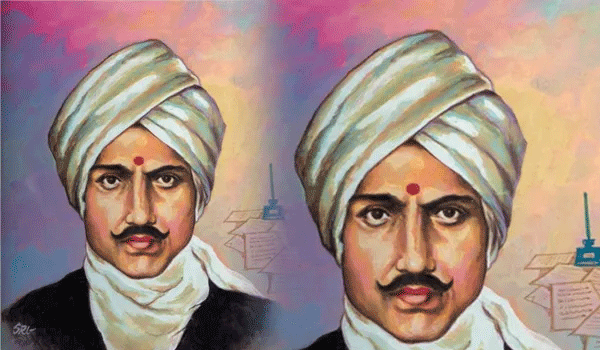
On his death anniversary, Bharathiyar’s life reminds us that true freedom is not merely political. It is civilisational, social and moral—a vision of Bharat united in spirit, fearless in thought, and compassionate towards its last citizen.
A Lonely Death, An Immortal Voice
On 11 September 1921, Chinnaswami Subramania Bharati—Bharathiyar to millions—passed away in Madras at just thirty-eight. He had been a poet, journalist, exile, reformer and nationalist firebrand. Yet, at his funeral, barely a handful of people gathered. Poverty, fear of British surveillance and the anxieties of the time kept many away.
History, however, has made amends in its own way. Today, Bharati’s words still burn with the conviction of a man who saw India as one civilisation long before it became one political republic. His death anniversary is therefore not merely a literary remembrance. It is an occasion to revisit how a boy from the small zamindari town of Ettayapuram grew into one of the most powerful voices of Indian nationalism—and how his idea of nationhood rose above language, caste, gender and region.
The Boy from Ettayapuram
Bharati was born on 11 December 1882 in Ettayapuram, in present-day Thoothukudi district of Tamil Nadu. His parents named him Subbaiah. His mother, Lakshmi Ammal, died when he was only five. His father, Chinnaswami Iyer, a Tamil scholar with an interest in mathematics and modern learning, wanted his son to study English, arithmetic and perhaps become an engineer.
The boy, however, belonged instinctively to poetry. He began composing verses at a young age, often ignoring formal schooling for the world of Tamil expression that had already seized his imagination. Around the age of eleven, in the Ettayapuram Raja’s assembly, he astonished scholars by composing and debating spontaneously. They gave him the title Bharati—one blessed by Saraswati. The name endured, even when fortune did not.
Early Hardship and a Wider Horizon
At fifteen, he was married to Chellamma, then only seven, as was customary in that period. Soon after, his father died following financial losses. The young poet was left with responsibility, little money and an uncertain future. He worked briefly as a court poet and later as a Tamil teacher at Sethupathi High School in Madurai for a modest salary. These were not steps in a comfortable literary career. They were signs of a life that would repeatedly test him through want, exile and hardship.
After his father’s death, Bharati spent time in Varanasi with his aunt. Those years widened his world. He learned Sanskrit, Hindi and English, passed the Allahabad University entrance examination, and absorbed the religious and political atmosphere of North India. He grew a beard, wore a turban, and began to look beyond the boundaries of the Tamil country. The boy from Ettayapuram had begun to imagine himself as a citizen of the entire civilisation of Bharat.
Journalism as a Weapon of Awakening
Journalism became his weapon. In 1904, he joined the Tamil daily Swadesamitran in Madras. Soon, the Swadeshi movement drew him into the centre of nationalist politics. He later edited India, Vijaya and Bala Bharatham, using print as a vehicle for political awakening. He attended the 1906 Congress session in Calcutta, met Sister Nivedita, and came into contact with leaders such as Bal Gangadhar Tilak, Lala Lajpat Rai, Sri Aurobindo and V. O. Chidambaram Pillai.
When the British cracked down on his writings in 1908, Bharati took refuge in French Pondicherry. Exile lasted nearly a decade. Money was scarce, his publications were banned in British India, and his family endured great hardship. Yet these were also years of extraordinary creativity. In Pondicherry, he wrote some of his finest works, including Kannan Pattu, Kuyil Pattu and Panchali Sabatham. He also helped carry the ideas of the national movement into Tamil political consciousness, ensuring that India’s freedom struggle did not remain confined to any one region or language.
A Nation Beyond Narrow Boundaries
Bharati’s nationalism was never narrow. He did not see India as a mechanical union of provinces, but as a living civilisational family. In Sindhunadhiyin Misai, he imagined the Indus, the Ganga, the Tamil country, Kerala and Maharashtra as parts of a single cultural and economic world. North and South were not adversaries in his imagination; they were strands of one fabric. Even when the Indus now lies across a political border, Bharati’s vision continues to speak to a deeper unity—one that geography alone cannot define.
His famous idea of a land with many faces, many languages and one heart captures the essence of Indian pluralism. Bharati loved Tamil intensely, but he did not turn that love into isolation. He knew Tamil, Sanskrit, Hindi, English, French, Telugu and some Arabic. His celebrated line that among the languages he knew, none was as sweet as Tamil, was not a rejection of other tongues. Rather, it was the confidence of a rooted Indian who could love his mother language deeply while engaging generously with the rest of the country. For him, Tamil pride and Indian unity strengthened each other.
Freedom for Women
Bharati’s idea of freedom was equally radical. A nation, he believed, could not be free if its women remained confined. His Pudhumai Penn—the new woman—was fearless, educated, politically aware and equal in dignity. At a time when orthodoxy resisted women’s education and public participation, Bharati spoke of women as builders of the nation, not as silent symbols of it. He imagined India herself as Shakti: not weak, not passive, but powerful, creative and dynamic.
The Moral Imagination of Bharati
His compassion was not merely theoretical. Stories of Bharati feeding sparrows from the rice borrowed for his hungry household may sound sentimental, but they reveal his moral imagination. For him, hunger anywhere was an indictment of society. A nation that allowed even one person to starve had failed its own soul.
The Poet the Nation Later Recognised
After returning from exile, Bharati lived in Kadayam and later in a rented house in Triplicane. He rejoined Swadesamitran, but his health and finances remained fragile. He often visited the Parthasarathy Temple, where he used to feed the temple elephant. One day, the elephant struck him. Though he survived the immediate blow, his health declined sharply. He died on 11 September 1921, almost unnoticed by the world for which he had sung so passionately.
The contrast is painful: a poet who had imagined India as one great household left the world with hardly anyone beside him. Yet his wife Chellamma preserved his manuscripts, and in 1949 the Madras government nationalised his works—the first time an Indian poet received such recognition. The nation eventually caught up with the man who had imagined it in advance.
Why Bharati Still Matters
Bharati did not live to see 1947. But he did not need independence to recognise India. He had already seen her as one heart in many languages, as a Mother of power rather than pity, and as a civilisation whose freedom had to include women, the poor and those crushed by caste.
That is why 11 September still matters. Bharati was not only the fiery poet of patriotic songs. He was a poor, restless, wounded and astonishingly modern Indian who refused to think small. From Ettayapuram’s modest lanes, he looked at the Indus, the Ganga and the Tamil shore and heard one song. Nalla kalam varuguthu, he wrote—a better time is coming. The most fitting tribute to him is not ritual remembrance alone. It is to keep alive his dream of a Bharat that is united without being uniform, rooted without being narrow, and free only when its last citizen stands with dignity.